Garmin Closed the Developer Door — Here's What That Costs Riders
Garmin has paused new API approvals with no reopening date, even as it launches its own subscription and buys TrainingPeaks. The bill for that lands on riders, and almost nobody tells them why.
Photo: Photo: CycleLytic
A few weeks ago we wrote about Garmin buying TrainingPeaks, and made a fairly relaxed prediction: with both products under one roof, the sync between them would get tighter and faster. That prediction still looks right. What we did not say — because it deserves its own piece — is what has been happening at the same time to everyone outside that roof.
Garmin has shut their API to new developers and is not accepting new apps.
Not slowed down. Stopped. The application form for new partners in the Garmin Connect Developer Program has been removed from the site, and requests for new API access have been paused with no published reopening date. Developers who applied months ago report the same holding response: review and approval of new API access requests is temporarily paused. As of September 10, 2026, the developer program's overview page carries no application form, no request-access link and no way to apply at all — only a box reading "Stay tuned for more updates on the program."
So the ecosystem got tighter in both senses of the word. Tighter integration for the platforms Garmin owns. Tighter shut for the ones it doesn't.
What the API Actually Does
It helps to be precise, because the loose version of this complaint is wrong and gets dismissed in one line.
You can still get your data out of Garmin. You can export a FIT file for any activity. You can request a bulk export of your whole account. Nobody has locked your rides in a vault. If you are willing to click through Garmin Connect and download files by hand, everything you recorded is yours to take.
What has closed is the automated path. The API is what lets a service you have chosen receive your rides continuously, without you doing anything — the thing that makes an integration feel like it just works, rather than like homework you do every Sunday evening.
That distinction matters, because "you can export manually" is technically true but practically useless. A training service that requires you to remember to upload every ride is a service you will stop using in short order.
What This Looks Like From the Other Side
We can be specific about this, because the integration is written and sitting in CycleLytic's codebase right now.
CycleLytic connects to Strava, ROUVY, Wahoo, Suunto and Hammerhead through their APIs. A rider links the account once and their rides arrive on their own, for as long as they keep riding. That is the normal shape of a modern integration, and every one of those companies made it possible by keeping a door open.
Until recently, Garmin offered the same thing — so we built for it. There is a module in CycleLytic that receives Garmin's activity notifications, downloads the file for a completed ride and reads it. There is a live webhook endpoint, deployed, waiting for Garmin to call it. Behind that sits the same parser and the same storage that already handle every other source in production.
It has never run once. Why? Because they shut the door.
We applied on 2 March 2026. After a first-day correction — they require a company-domain contact address, which is reasonable, and which we supplied the same day — the application was accepted: "Your request has been successfully verified and is currently in the approval process, which typically takes up to two business weeks."
Those two weeks came and went. At four weeks we received the same message again with one word changed: approval "may take up to a few business weeks". At six weeks, and again at eight, nothing at all.
In May we asked separately about pushing structured workouts to riders' Garmin calendars. Garmin Connect Partner Services replied:
"The application form for new API access requests is currently unavailable while we complete updates to the Garmin Connect Developer Program. During this transition, new access requests are temporarily paused. Once the updated developer program and application process are finalized, the access request form will be made available again on our developer website."
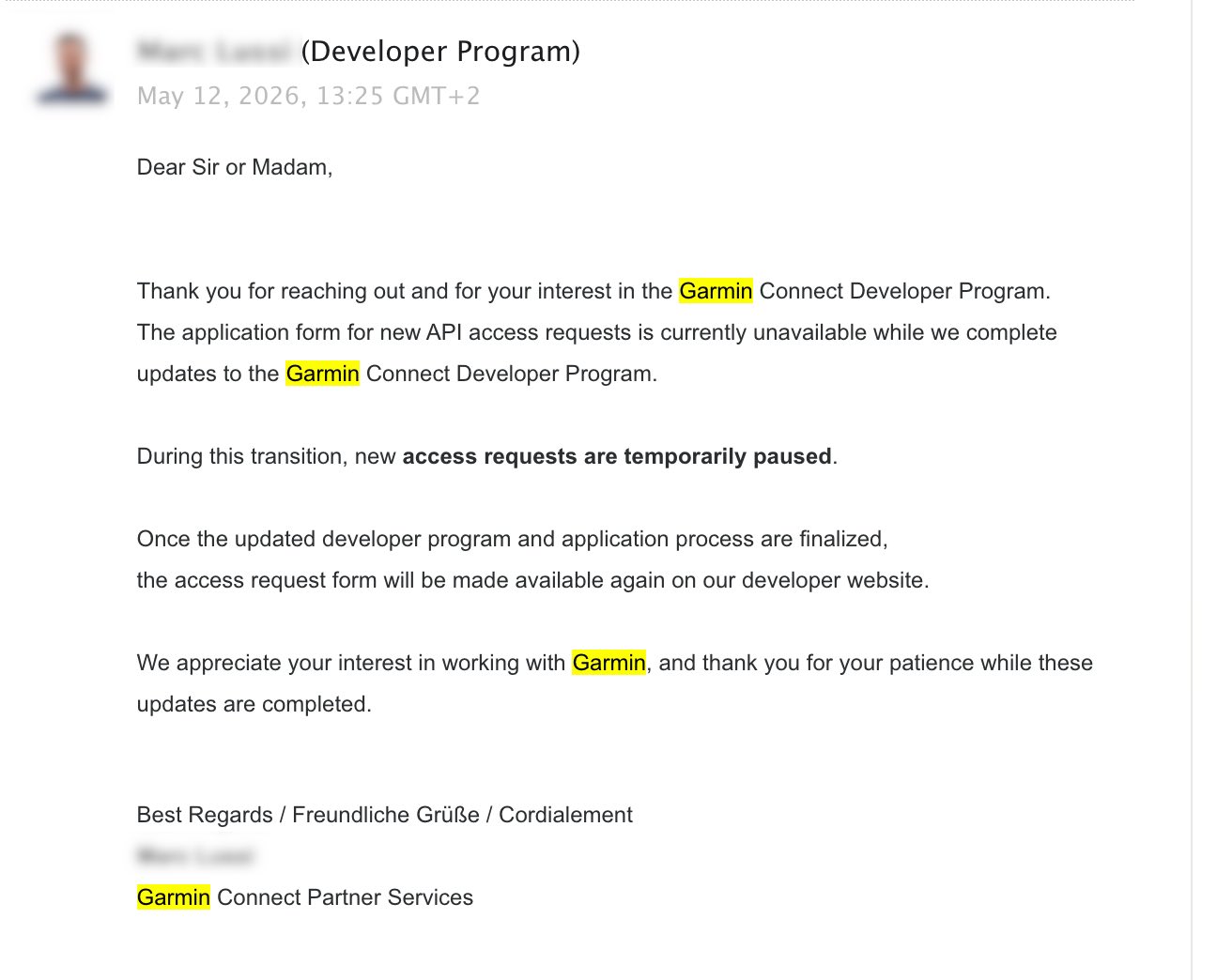
Eight days later, chasing the original application into its eleventh week, we were given the fuller version:
"Currently, API access request processing is temporarily delayed as we are currently working through a significant redesign and modernization of the API program and related processes. As a result, we are not yet able to process new requests in the queue. Unfortunately, we are unable to provide an estimated timeline for when request processing will resume."
That was four months ago. The form is still down, and the application we filed on 2 March has never been approved or rejected. It has simply never been decided.
We quote both in full because they are polite, they are clear, and they are the only answers anyone gets. Read in order, the estimate goes from two business weeks, to a few business weeks, to no timeline at all. "Temporarily" is doing a great deal of work.
One detail is worth holding on to. Our application was verified and admitted to the approval process on 2 March, before any of this. It was not turned away at the door. It was already inside the queue when the queue stopped moving.
Is Connect IQ a Substitute?
At this point someone always says: but Connect IQ is open, isn't it?
It is, genuinely, and it is a real credit to Garmin that it exists. You can write apps and data fields that run on a Garmin device itself, publish them on the Connect IQ store, and riders can install them freely. We have used it — we push CycleLytic data out to the head unit.
But Connect IQ is an output channel, not an input one. A data field can put our numbers on your Edge screen while you ride. It cannot hand us your ride afterwards. Garmin owns the recording, the FIT file and the upload, and none of that is ours to receive no matter what we run on the device. It also requires the rider to install an app on the device in the first place — another barrier in front of the thing they were trying to do.
So Connect IQ is not a workaround for the closed API. It is a different thing that is sometimes mistaken for one — including, occasionally, by people arguing that the ecosystem is more open than it is.
The Route That's Left
For a Garmin user who wants to use CycleLytic today, the path is: Garmin to Strava, Strava to us.
It works. It is also worth looking at squarely. Your ability to use our service relies entirely on two primary players: Garmin and Strava. One has already closed the door. Who is to say the other will not decide to do the same? Strava is under no obligation to keep its API open forever, and if it ever narrows access the way Garmin has, Garmin users lose an entire category of software overnight — and neither company will have to explain why.
That is not a resilient arrangement. It is one open door away from no doors.
The Cost Nobody Itemises
Here is the part that gets lost when this is framed as a developer problem.
Developers are not really the injured party. We wrote the integration, it cost a few days, and it will sit there costing nothing until something changes. Annoying, not damaging.
The rider — the user — pays, and pays without ever being told there is a bill:
- A connection that should be direct, isn't. You own the device. We wrote the code. You still have to route through a third company to get one to talk to the other.
- The blame lands in the wrong place. When Garmin is missing from a service's list of sources, riders reasonably conclude the service could not be bothered. Almost always it is the other way round.
- Features that quietly never appear. Some things need a live data pipe. When they don't show up there is no announcement — the feature simply isn't there, and nobody says why.
- Fewer services, full stop. A developer sizing up the endurance market in 2026 sees a closed door with no reopening date and builds somewhere else. You will never see the products that are killed.
- Less pressure on the incumbents. Competition is what makes platforms improve. It is hard to be out-innovated by companies that cannot get an API key.
The Timing Is the Story
Any one of these facts on its own is a business decision. Together they describe a strategy.
Garmin sells Connect+, its own paid subscription tier, at $6.99 a month or $69.99 a year. In July 2026 it acquired TrainingPeaks and TrainHeroic, bringing one of the most deeply embedded training platforms in endurance sport in-house. And the front door for new third-party developers is shut, indefinitely, with no stated criteria for reopening.
We are not going to tell you that it is a conspiracy. Companies are allowed to build their own products and buy others. Running a public API has a real cost, and support burden and privacy exposure are legitimate reasons to throttle one.
But the sequencing is worth noticing. The moment a platform starts selling subscriptions in the same category as its API partners, "we've paused new approvals" stops being a neutral operational note.
Whose Data Is It?
This is where the argument usually reaches for a principle, so let's be careful about which one.
The data is generated by you — a record of your body and your afternoon, captured by a device you paid several hundred for. The instinct that it should follow you to whatever service you choose is a decent one, and portability rules in several jurisdictions point roughly that way.
But we are not going to claim a settled legal right is being violated, because there probably isn't one. Manual export exists, and that may satisfy the letter of every portability rule that applies.
The gap is between the letter and the point. Portability that requires you to hand-carry files is portability in the same way that a locked gate with a stile beside it is an open field. Technically passable. Not actually a path.
What Would Fix It
Not much, and none of it is radical:
- Reopen approvals, with published criteria and a queue people can see. Even a slow, selective process beats an unmarked door.
- Say the quiet part out loud. If new access is closed for the foreseeable future, publish that. Developers can plan around a no. They cannot plan around silence.
- Make automated export a user right, not a partner privilege. If Garmin doesn't want to vet every developer, let riders authorise their own data to flow to a service of their choosing — the model Strava has run for over a decade without the sky falling. (CycleLytic would seriously consider running a repository of exactly that kind: somewhere a rider stores their own data and releases it to whomever they like.)
Where This Leaves You
If you use a Garmin for your rides and want to use anything beyond Garmin's own ecosystem, your practical options today are Strava as a relay, a Connect IQ workaround where a developer has built one, or manual file exports.
That is a worse set of options than you had two years ago, and nothing about your device got worse. The change was policy.
We will keep our webhook deployed, because it costs us nothing and the day the door reopens we are a config value away from working. But it is worth knowing that the friction you hit is not where you think it is — and that it was chosen, by someone, on your behalf.
CycleLytic is an independent, terrain-first cycling analytics platform. We connect to Strava, ROUVY, Wahoo, Suunto and Hammerhead, and support direct .FIT and .GPX upload. Our Garmin integration is written, deployed and inert, pending an approval process that is not currently open to anyone.
Turn your rides into real gains
You just read the tech — now see it in your own data. CycleLytic reads your climbs, power, and terrain: the context Strava and Garmin leave out.
Start 3 months free →No card required · cancel anytime